

Introduction
Pressure washer fittings directly affects cleaning efficiency, safety, and leak prevention. Good fittings are long-term stability and leak free. They ensure that water pressure is fully delivered to the spray gun or nozzle. But incompatible or low-quality fittings can cause sudden disconnections or bursts, posing safety hazards to the user and damaging the equipment. Even a small leak can lower pressure, waste water, and create unnecessary mess during operation.
In this guide, we’ll explain the difference between fittings and how to choose the right ones for your pressure washer.
What’s the difference between the common types of fittings?
1. Quick Connect (QC):
Designed for fast and easy attachment or removal without tools. We can simply push and click the coupler into place. They are ideal tools for the ones who frequently change accessories like guns, wands, or foam cannons. The most common types for pressure washer include:
1/4” Quick Connect: Widely used for nozzles and accessories.
3/8” Quick Connect: Often found in commercial-grade pressure washers.
Couplers and Plugs: Female and male fittings are designed to pair seamlessly.

2. Threaded Fittings:
The common types are NPT and BSP. They provide a tighter, leak-proof seal but cost longer time to connect or disconnect. Common in professional or permanent setups.
3. Swivel Type:
Designed to rotate freely, preventing hose twisting or tangling during operation. Great for improving comfort and extending hose life.

Common types of fitting on gas, electric, and fuel-powered pressure washers
1. Electric Pressure Washers
Electric washers operate at lower PSI (typical pressure range:1000–2500 PSI). So they use smaller fittings and lighter materials (often brass or plastic). M22-15mm thread is the most typical for consumer-grade units (e.g., Karcher, Sun Joe, Greenworks)
Tip: Always confirm whether your unit uses M22-14mm or M22-15mm — mixing them causes leaks.

2. Gas Pressure Washers
Gas machines have higher GPM and PSI (typical pressure range: 2500–4500 PSI). So they need larger diameter and more durable fittings (usually stainless steel or brass).
Common attachment:
3/8" Quick Connect: for hoses and spray guns
M22-14mm thread: on the pump outlet or hose inlet
3/8" NPT threaded: connections for high-pressure components
Tip: Use stainless steel quick connects for durability and corrosion resistance under high pressure.
3. Fuel Pressure Washers
They are built for industrial and commercial use (typical pressure range: 4000–8000 PSI), requiring fittings rated for high PSI and thermal stress.
Common attachment:
3/8" or 1/2" Quick Connects for high-flow hoses
3/8" NPT / BSPT threaded fittings for pumps and guns
Tip:
1. Heavy-duty stainless steel couplers to handle extreme pressure and temperature.
2. Never use consumer-grade brass fittings on a fuel-powered machine — they can burst under pressure.
Please Note:
The hose diameter does not indicate the fitting size required. For example, a 5/16" hose may have an M22, 3/8" threaded, or quick connect fitting at the ends. Therefore the fitting can vary despite the hose diameter.
What's the difference of the materials?
Fitting Material Differences
1. Brass:
✅ Corrosion-resistant, affordable, good for residential use.
❌ Softer than stainless steel, wears faster under high pressure.
2. Stainless Steel:
✅ Extremely durable, rust-proof, ideal for heavy-duty or commercial applications.
❌ Slightly more expensive, but offers the best long-term performance.
3. Plastic:
✅ Lightweight and low-cost, suitable for light-duty electric washers.
❌ Weak under high PSI, prone to cracking or leaking over time.
O-Ring Material Differences
The O-ring provides the watertight seal between fittings. Choosing the right material improves durability and prevents leaks.
NBR (Nitrile Rubber): Common and affordable, good for cold-water use. It is suitable for Home and light commercial use, common used for electric pressure washers.
Viton: High chemical and heat resistance — best for hot-water or detergent use. It is frequent used in car wash, industrial cleaning, or professional setups, common used for gas pressure washers.
EPDM: Excellent resistance to weather, ozone, and mild chemicals; good for general applications. It is best suited for long-term outdoor use, common used for fuel-powered/heavy-duty commercial washers.
How to Match Fittings Correctly among the spray gun, hose and pump?
1. From Pump to Hose
The pump outlet delivers high-pressure water. It usually uses a male M22 thread or 3/8" quick connect plug. The hose inlet should match a female M22 or 3/8" quick connect coupler. Don’t forget to check whether your pump has M22-14mm or M22-15mm threads, or you will face with leaks or poor sealing.

2. From Hose to Spray Gun
The common connection types include 3/8" quick connect, M22 thread, or 1/4" plug (depending on pressure level). If you want faster setup, use quick connect fittings on both ends of the hose—this lets you swap spray guns or foam cannons in seconds.
3. From Spray Gun to Nozzle / Accessories
The spray gun outlet (usually 1/4" quick connect) attaches to the wand, nozzle, or foam cannon.
Quick connect fittings are universal here—easy to replace or upgrade accessories without tools.
Simple Matching Logic Overview
|
Connection |
Common Type |
Example |
|
Pump → Hose |
M22 / 3/8" QC |
M22 male (pump) → M22 female (hose) |
|
Hose → Gun |
3/8" QC / M22 |
3/8" plug (hose) → 3/8" coupler (gun) |
|
Gun → Nozzle |
1/4" QC |
1/4" plug (nozzle) → 1/4" coupler (gun) |
PSI Rating and Flow Matching
When choosing pressure washer fittings, it’s essential to match both PSI (Pressure per Square Inch) and GPM (Gallons per Minute) to ensure safe and efficient operation.
PSI (Pressure): Measures the force of the water. Higher PSI = stronger cleaning power.
GPM (Flow Rate): Measures how much water flows through the system per minute. Higher GPM = faster rinsing and larger coverage.
A well-balanced system delivers both high pressure and adequate flow—the fittings must support both to prevent restrictions or failures. If your fittings are rated below the washer’s PSI, they can burst or leak under pressure. If the internal diameter of the fittings is too small, it restricts water flow, reducing cleaning efficiency and increasing pump strain. Oversized fittings may reduce pressure and make the spray weaker.
Recommended Matching Guide
|
Washer Type |
Typical PSI Range |
Typical GPM |
Recommended Fitting Type |
|
Electric |
1000–2500 PSI |
1.2–2.0 GPM |
M22-15mm, 1/4" QC |
|
Gas |
2500–4500 PSI |
2.5–4.0 GPM |
M22-14mm, 3/8" QC |
|
Commercial / Industrial (Fuel) |
4000–8000 PSI |
4.0–8.0 GPM |
3/8"–1/2" QC, NPT Threads |
Conclusion
The fittings are very important parts of our pressure washing. It's totally worth to spend time to handpicked with care!
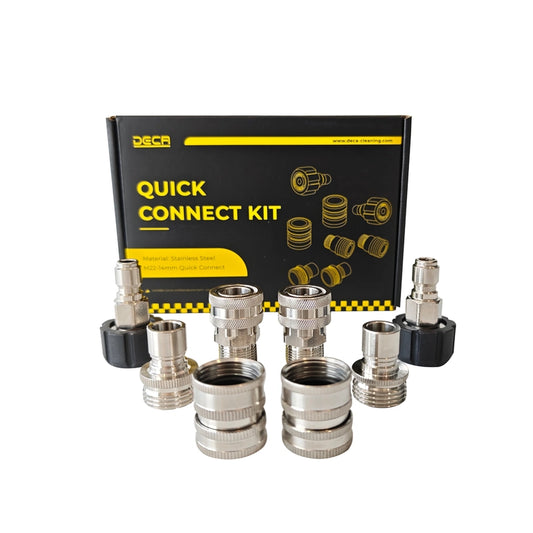
Explore DECA stainless steel fittings now!


