

When it comes to deep-cleaning tough surfaces, regular nozzles often fall short. They either provide a narrow, super-powerful stream that risks surface damage and is slow to use, or they offer a wide, gentle spray that isn't effective on heavy grime. This is where the rotary turbo nozzle steps in.
Let's explore why this accessory is often the best choice for pressure washing.
The Problem with Standard Nozzles
Standard pressure washer nozzles (often color-coded from 0° to 40°) are essential tools, but they have distinct limitations:
Narrow Streams (0° to 15°): These offer maximum force at a single point, making them great for cutting through incredibly tough substances like concrete splatter. However, they are dangerously aggressive for many surfaces (like wood decks or vehicles), and their coverage is so small that cleaning a whole driveway would be an agonizingly slow process.
Wide Streams (25° to 40°): These are safer and cover a larger area in each pass, making them perfect for general tasks like washing cars. The drawback is their reduced impact force. For ground-in dirt, mildew, and oil stains on porous concrete, they just don't have the power to lift the grime effectively.
Cleaning tough ground-in stains usually requires a choice: risk damaging your surface by getting a narrow nozzle close up, or spend hours with a wider nozzle that isn't very effective.
Enter the Rotary Turbo Nozzle: A True Revolution
A rotary turbo nozzle solves this dilemma through an ingenious design. It combines powerful cleaning force with wide, efficient coverage.
Inside the nozzle head is a high-speed rotating mechanism. As high-pressure water enters, it's channeled into a spinning motion. This spinning action rotates a narrow nozzle tip in a rapid, cone-shaped pattern thousands of times per minute.
The result is a single cone-shaped spray pattern. When you pull the trigger, you get a powerful, concentrated jet of water that is rapidly oscillating across a wide circular area.
Seamless Connection to Your Spray Wand
One of the best features of a rotary turbo nozzle is how easily it integrates into your existing setup. You don't need any complicated tools or adapters to start using it:
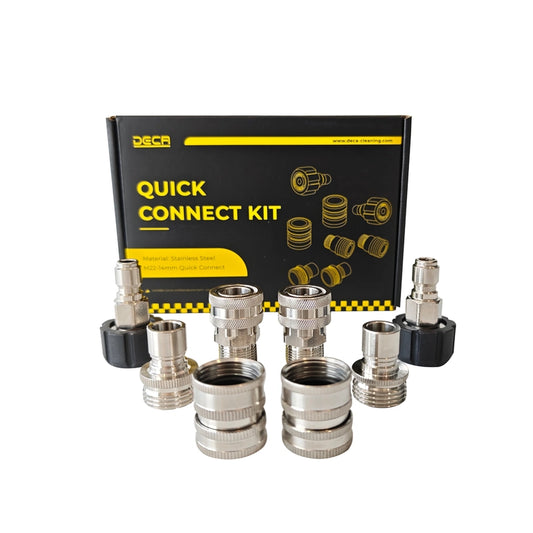
Easy Plug-and-Play: Most turbo nozzles come equipped with a standard 1/4" quick-connect plug. This allows you to snap the nozzle directly into the female coupler at the end of your pressure washer's extension wand or lance in just a second.
Instant Upgrade: It swaps out just like your standard colored spray tips. This means you can switch from a gentle rinse tip to a high-power turbo nozzle instantly, transforming your standard spray gun into a professional-grade cleaning machine.
Threaded Options: For certain heavy-duty or professional setups, threaded options (such as M22 connections) are also available to screw securely onto compatible lances for a leak-free, heavy-duty seal.
Key Benefits of Using a Rotary Turbo Nozzle
When you harness this technology, you unlock several powerful advantages:
Unmatched Deep-Cleaning Force: The concentrated, narrow jet has the raw power to lift ground-in dirt, mildew, and many oil stains from concrete and brick, far exceeding the capability of a standard wide fan spray.
Massively Increased Cleaning Speed: Because the powerful jet is covering a wide, sweeping area in a single pass, you can deep-clean whole surfaces much faster than you ever could with a narrow, static nozzle alone.
Superior Surface Protection (When Used Correctly): The jet is never static; it's constantly moving. This means no single spot gets the full, unyielding force of a narrow pencil jet. When you pull back to the appropriate distance, the impact is distributed, making it safer for porous surfaces compared to a static jet.
Even Cleaning Pattern: Standard fan sprays can sometimes leave an uneven or striping pattern. The rotating action of a turbo nozzle creates a highly uniform and consistent deep-cleaning across the entire cone-shaped pattern.
Summary
A rotary turbo nozzle doesn't force you to choose between brute force and efficient coverage. It gives you focused impact power deployed over a wide area with speed and safety. It is, quite simply, the most effective tool available for the deep-cleaning and restoration of patios, driveways, and brickwork.
For anyone who values both powerful cleaning and efficient, safe performance, adding a turbo nozzle to your spray wand is an essential and transformative upgrade.


