

If you are operating a heavy-duty pressure washer rated at 4200 PSI, you already know the incredible ripping power it delivers to blast through grease, stripped paint, and decades of industrial grime.
But here is the hard truth: Your machine is only as strong as its weakest link. And usually, that link is your hose.

Have you ever had a hose suddenly bubble, leak, or violently pop right in the middle of a commercial job? It’s not just frustrating—it’s a massive safety hazard. A line snapping at 4200 PSI can cause severe fluid injection injuries and instant equipment downtime.
In this guide, we will break down the exact technical specs you need to look for so you never have to deal with a blown-out hose on the job site again.
1. The Trap: "Working Pressure" vs. "Burst Pressure"
The most common mistake people make when buying a replacement hose on Amazon or at local big-box hardware stores is misreading the pressure rating.
Many budget, residential-grade hoses proudly stamp "4000 PSI" or "4500 PSI" on their retail packaging. However, if you read the fine print, that is often their Burst Pressure—the absolute maximum limit the hose can take for a fraction of a second before exploding.
Working Pressure: The continuous pressure the hose is engineered to handle safely day in and day out during operation.
Burst Pressure: The catastrophic failure point under extreme spikes.

⚠️ Pro Rule: For a 4200 PSI commercial pump, your hose’s Working Pressure MUST be > 4200 PSI (ideally rated at 4200–4500 PSI working pressure, featuring a 4:1 safety factor meaning a burst rating around 16,000 PSI). Anything less is a ticking time bomb for your rig.
2. Construction: Why Steel Wire Braid is Non-Negotiable
Plastic, nylon, or basic vinyl hoses are perfectly fine for a standard 2000 PSI residential power washer. But at 4200 PSI, the water velocity and pressure inside are exerting immense outward force. You need heavy-duty structural reinforcement.
Look for hoses constructed with High-Tensile Steel Wire Braiding.

Single Braid vs. Double Braid
● Single Wire Braid: Offers excellent flexibility and easily handles 4200 PSI while keeping the hose lightweight and easy to manage on a reel. Perfect for mobile detailers and residential contract cleaners.
● Double Wire Braid: Two layers of interwoven steel. It’s heavier and stiffer, but it provides maximum protection against extreme pressure spikes and rugged commercial abuse.
Additionally, pay attention to the outer jacket. If you are dragging the hose across rough concrete, asphalt, or around heavy machinery, choose a Premium Polyurethane or Non-Marking Rubber jacket. It resists intense abrasion and won't leave ugly black streaks across your client's freshly cleaned driveway or commercial property.
3. Inner Diameter & Fittings: Don’t Choke Your Flow
You can have the strongest commercial pump and the toughest hose, but if your fittings restrict the water, your cleaning efficiency plummets.
Hose Inner Diameter (I.D.)
For 4200 PSI professional setups, 3/8-inch (3/8") Internal Diameter is the industry standard.
Do not buy a 1/4" hose for a 4200 PSI machine. A 1/4" hose severely restricts the volume of water (GPM - Gallons Per Minute), creating massive friction loss inside the tube. This means by the time the water reaches your spray gun, you’ve lost significant cleaning impact, and your pump is working twice as hard (leading to overheating
、Fittings & Connections
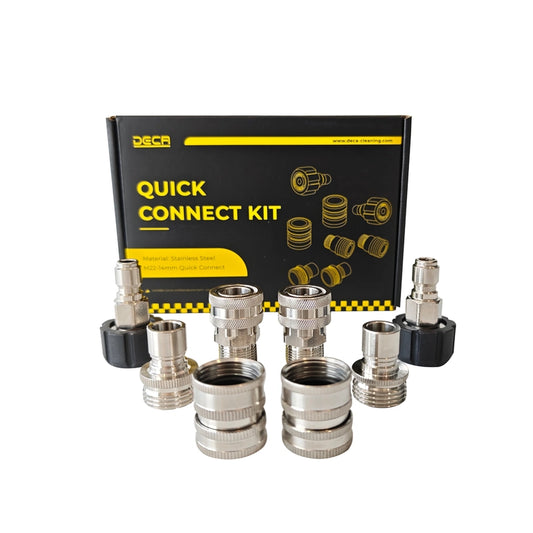
● Quick Connects (QC): Look for 3/8" stainless steel or heavy-duty brass quick connects. They allow you to snap lines together in seconds without carrying wrenches around the job site.
● M22 Twist Links: If your machine uses twist connections, verify if it is M22-14mm or M22-15mm. Forcing a 14mm hose onto a 15mm pump pin will instantly shred the O-ring and cause relentless leaking.
Final Verdict: Protect Your Rig
Investing in a high-end 4200 PSI pressure washer but cutting corners on a cheap retail hose is like putting budget commuter tires on a supercar. It ruins the performance and risks a dangerous blowout.
When shopping for your next replacement line, stick to the 4200 PSI Working Pressure standard, demand steel wire braiding, and ensure you are running a 3/8" I.D. for maximum flow. Your pump, your clock, and your safety will thank you.


