

A foam cannon should produce a dense layer of foam that stays on the surface long enough to loosen dirt. If the foam is thin, watery or uneven, the problem may not be the foam cannon itself.
Water flow, detergent, adjustment settings and internal components all affect foam quality. Use the following checks to identify the cause.
1. The Detergent Is Too Diluted
Too much water in the bottle is one of the most common reasons for watery foam.
Check the detergent manufacturer’s dilution instructions. Some concentrated soaps require only a small amount, while others need a stronger mixture.
Do not assume that adding more detergent always creates better foam. Excessive soap can leave residue and waste product.
Fix: Mix the detergent according to the recommended ratio and test it before making further adjustments.
2. The Detergent Is Not Designed for Foam Cannons
Not every cleaning solution produces thick foam. General-purpose cleaners and pressure washer detergents may clean effectively but generate fewer bubbles.
Fix: Use a high-foaming detergent specifically designed for foam cannons. For vehicle cleaning, choose an automotive shampoo that is safe for paint, wax and protective coatings.
3. The Foam Adjustment Is Set Too Low
The top adjustment knob controls how much detergent enters the water stream. If it is set toward the water-only position, the cannon will produce thin foam.
Fix: Turn the top adjustment gradually toward the maximum-foam setting. Make small adjustments and test the output after each change.
The front nozzle controls the spray width, not the detergent concentration.
4. The Pressure Washer Has a Low Flow Rate
Foam quality depends heavily on water flow, measured in gallons per minute (GPM). A machine may have a high PSI rating but still lack sufficient flow to create dense foam.
Fix: Check the pressure washer’s PSI and GPM specifications. Make sure the water supply is fully open and the inlet hose is not kinked or restricted.

5. The Orifice Is Too Large
The orifice is the small opening inside the foam cannon that controls water velocity. Lower-flow electric pressure washers may produce better foam with a smaller orifice, such as a 1.1 mm option.
An orifice that is too large may not create enough suction to draw detergent effectively.
Fix: Confirm that the orifice size matches the pressure washer’s flow rate. Do not install a smaller orifice without checking the equipment specifications.
6. The Pickup Tube Is Loose or Blocked
The tube inside the bottle draws detergent into the brass valve body. If it is disconnected, cracked, blocked or positioned above the liquid, the cannon may draw little or no soap.
Fix:
1.Remove the bottle.
2.Check that the pickup tube is firmly attached.
3.Confirm that its end remains submerged.
4.Rinse away dried detergent or debris.
5.Replace the tube if it is cracked or hardened.
7. The Mesh Filter Is Clogged
The internal mesh filter helps mix water, detergent and air into fine bubbles. Dried soap, mineral deposits and debris can restrict it, resulting in weak or uneven foam.
Fix: Disconnect and depressurize the system before inspection. Clean the foam cannon according to the manufacturer’s instructions.
After each use, fill the bottle with clean water and run the cannon briefly to flush out remaining detergent.
8. The Water Supply or Connection Is Restricted
A partially closed faucet, kinked hose, clogged inlet filter or incorrect fitting can reduce water flow before it reaches the foam cannon.
Air entering through a loose connection may also cause inconsistent spray.
Fix: Inspect the complete water path:
-
Fully open the water supply
-
Straighten kinked hoses
-
Clean the pressure washer inlet filter
-
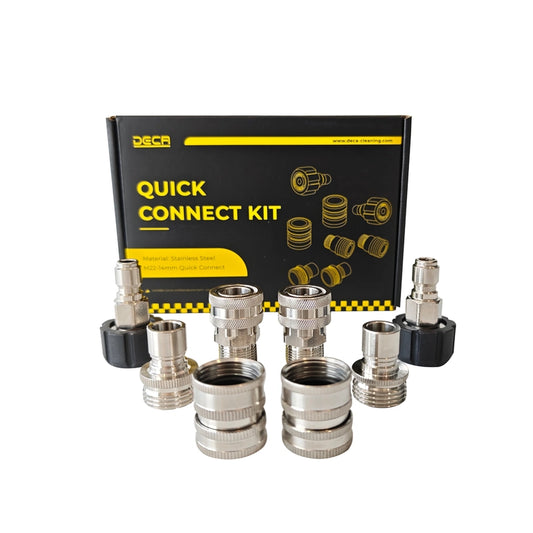
Check quick-connect fittings
-
Inspect O-rings for wear
-
Confirm that the foam cannon plug is fully seated

Quick Troubleshooting Guide
| Symptom | Likely Cause | Recommended Check |
|---|---|---|
| Foam is watery | Weak mixture or low adjustment | Check dilution and top knob |
| Cannon sprays only water | Pickup tube problem | Inspect the internal tube |
| Foam output pulses | Restricted water supply or air | Check hoses and connections |
| Spray is uneven | Blocked nozzle or mesh filter | Flush and clean the cannon |
| Foam is weak on an electric washer | Incorrect orifice size | Check machine GPM and orifice |
| Connection leaks | Damaged or incorrectly seated O-ring | Inspect the quick-connect fitting |
How to Prevent Foam Cannon Problems
After every use:
1.Empty the remaining detergent.
2.Rinse the bottle with clean water.
3.Run clean water through the cannon.
4.Allow the components to dry.
5.Store the cannon away from freezing temperatures.
6.Avoid leaving detergent inside for long periods.
Regular flushing helps prevent dried soap from blocking the pickup tube, orifice and mesh filter.

Choose a Reliable DECA Foam Cannon
The DECA 1L Foam Cannon features a translucent reservoir, solid brass core, adjustable foam concentration and an adjustable spray pattern.
It is rated for up to 5000 PSI and 5.5 GPM. Actual foam performance still depends on the pressure washer’s flow rate, detergent mixture, water supply and selected orifice.
Before connecting any accessory, confirm the PSI, GPM and quick-connect compatibility of the complete system.
To understand the operating principle in more detail, read What Is a Foam Cannon and How Does It Work?.
Final Thoughts
When a foam cannon does not produce thick foam, begin with the simplest checks: detergent ratio, adjustment setting and water supply. Then inspect the pickup tube, orifice and mesh filter.
Changing one factor at a time makes it easier to identify the actual cause without replacing parts unnecessarily.


