

A pressure washer hose can look compatible and still be the wrong choice. The fittings may not connect, the working-pressure rating may be too low, the diameter may restrict a higher-flow system, or the hose may be inconveniently short—or unnecessarily long—for the job.
If you are learning how to choose the right pressure washer hose, check seven things before buying: working pressure, inner diameter, connection type, connection size, length, material, and temperature rating. This guide walks through each decision so you can select a hose that fits both your equipment and the way you clean.
Pressure Washer Hose Buying Checklist
Before comparing brands or colors, write down these specifications from your pressure washer manual and current hose:
1.Maximum operating PSI
2.Rated GPM
3.Hose inner diameter
4.Inlet and outlet fitting types
5.M22 inner diameter, if the system uses M22 fittings
6.Maximum water temperature
7.Required hose length
Never identify a fitting by appearance alone. Measure it, check the manual, or compare it with a verified fitting diagram.
1. Match the Hose Working-Pressure Rating
The replacement hose’s working-pressure rating must meet or exceed the pressure washer’s maximum operating pressure. The hose should never be the lowest-rated part of the pressurized system.
For example, a hose rated for 3,200 PSI may be appropriate for a compatible machine operating at or below that pressure. It is not the correct choice for a machine whose maximum operating pressure exceeds the hose rating. A 4,200 PSI hose can be used on some lower-pressure systems, but only when its diameter, fittings, temperature rating, and flow capacity also match.
Do not confuse working pressure with burst pressure. Working pressure is the relevant rating for normal operation. Burst pressure is a test or failure threshold and should not be treated as an operating target.
For more detail, read Can You Use a 4200 PSI Hose on a 3200 PSI Pressure Washer?.
2. Choose the Correct Hose Diameter
Hose diameter affects flow capacity, weight, flexibility, and the fittings normally used with the hose. The two common sizes in DECA’s range serve different kinds of setups.
| Hose size | Common use | Main advantages | What to verify |
|---|---|---|---|
| 1/4 inch | Many residential and light-duty pressure washer setups | Lighter and easier to handle; commonly paired with M22 connections | Machine GPM, maximum PSI, M22 size, temperature, and length |
| 3/8 inch | Higher-flow and commercial-compatible setups | Greater flow capacity and a more heavy-duty hose format | Machine connection, quick-connect size, working PSI, temperature, and whether adapters are required |
Do not assume a larger hose automatically improves every pressure washer. A 3/8-inch hose may require adapters and can add weight. A 1/4-inch hose may be easier to manage for home cleaning, but it still has to support the machine’s pressure and flow. Use the diameter specified by the manufacturer unless the equipment documentation confirms another size is suitable.

3. Match Both Hose Connections
A pressure washer hose has two ends, and both must match. One end connects to the pressure washer or pump outlet; the other connects to the spray gun. A correct connection should seat fully and seal without being forced.
M22-14 mm and M22-15 mm Are Different
M22 describes the outside thread, while 14 mm or 15 mm describes the inner fitting size. The two can look almost identical. A mismatch may fail to seal, create a leak, or prevent the fitting from seating correctly.
3/8-Inch Quick-Connect Is Common on Heavy-Duty Hoses
Many higher-flow hose setups use a 3/8-inch quick-connect plug and coupler. Confirm which side requires the plug and which side requires the socket. Also verify whether the gun and pressure washer already have compatible adapters.
1/4-Inch Quick-Connect Is Usually Used at the Accessory End
The 1/4-inch quick-connect format is commonly used between the spray gun or wand and accessories such as nozzle tips or a foam cannon. Do not assume that a 1/4-inch nozzle connection means the high-pressure hose itself is 1/4-inch quick-connect.
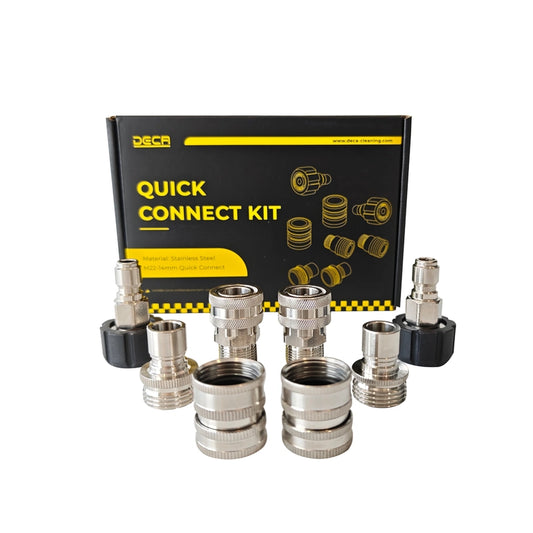
Use the Pressure Washer Quick Connect Size Guide to identify the fitting, then follow How to Install a Pressure Washer Quick Connect Kit if adapters are needed.

4. Select the Right Hose Length
Choose enough length to reach the work area without constantly moving the pressure washer, but avoid buying extra hose with no practical purpose. More hose means more material to carry, uncoil, drain, and store. System behavior can also change with length, especially when fittings, diameter, water supply, or flow are already marginal.
| Length | Best suited to | Tradeoff |
|---|---|---|
| 25 ft | Cars, small patios, compact work areas | Light and easy to store, but limited reach |
| 50 ft | Driveways, decks, siding, general home use | A practical balance of reach and handling |
| 100 ft | Large properties and jobs where the machine must stay in one location | Maximum reach, but more weight and more hose to manage |
Measure the path you will actually take around vehicles, landscaping, corners, and buildings. Do not measure only in a straight line. For a deeper comparison, see the Pressure Washer Hose Length Guide: 25FT vs. 50FT vs. 100FT.
5. Compare Hose Materials and Construction
Material affects flexibility, abrasion resistance, weight, kink behavior, and how the hose feels in different weather.
Flexible TPU Hose
A thermoplastic polyurethane hose is a practical choice when low weight and easy handling are priorities. DECA’s green 1/4-inch M22 hose uses flexible TPU construction and is offered in 25-, 50-, and 100-foot lengths. It is intended for compatible systems operating within its 3,200 PSI rating.
Steel-Braided Hose
A steel-braided hose is designed for more demanding environments where higher pressure capacity and rugged construction are priorities. DECA’s blue 3/8-inch 1SC steel-braided hose is rated up to 4,200 PSI and uses quick-connect adapters. Confirm connector configuration, GPM, temperature, and machine compatibility before purchasing.
No hose is kink-proof or damage-proof. Keep every hose away from sharp edges, hot exhaust components, traffic, and chemical spills unless the hose is specifically rated for that exposure.
6. Check the Temperature Rating
Pressure and temperature ratings are separate. A hose that is suitable for a cold-water pressure washer may not be suitable for a hot-water system.
Confirm the maximum water temperature for the hose, spray gun, seals, fittings, and attachments. The safe system limit is the lowest temperature rating among all connected components. Never rely on hose color or appearance to identify hot-water compatibility.
7. Think About Flexibility, Kink Resistance, and Storage
A hose that constantly twists or kinks can interrupt flow and make cleaning frustrating. Lay the hose out before starting, remove loops, and avoid pulling it tightly around corners. When the job is finished, release pressure, drain the hose, and store it in broad coils.
If kinking is a recurring problem, see How to Prevent a Pressure Washer Hose from Kinking for setup and storage advice.
Which Pressure Washer Hose Should You Choose?
Use this quick comparison as a starting point, then confirm every specification against your equipment manual.
| Cleaning setup | Good starting point | Why |
|---|---|---|
| Car washing and light home maintenance with a compatible residential machine | 1/4-inch flexible hose with the correct M22 connections | Easier handling and storage for routine home cleaning |
| Driveways, patios, and general residential work | 1/4-inch or 3/8-inch hose as specified by the machine | The correct choice depends on PSI, GPM, fittings, and desired reach |
| Higher-flow or commercial-compatible equipment | 3/8-inch heavy-duty hose with verified quick-connect fittings | Greater flow capacity and a higher-pressure hose format |
| Long-distance work around a property | 50- or 100-foot hose in the specified diameter | More reach, with additional weight and storage requirements |
For compatible residential systems, compare the DECA 1/4-inch M22 pressure washer hose rated up to 3,200 PSI. For compatible higher-pressure and higher-flow setups, review the DECA 3/8-inch steel-braided pressure washer hose rated up to 4,200 PSI.
If you need a coordinated hose-and-gun package rather than a hose alone, compare the DECA 3/8-inch 50 FT hose and gun kit rated up to 4,200 PSI after checking its connections and specifications against your equipment.

Common Pressure Washer Hose Buying Mistakes
Buying by Color
Color may help distinguish products, but it does not confirm pressure, diameter, fitting, or temperature compatibility. Read the specifications.
Matching Only One End
A hose can fit the pressure washer and still fail to connect to the spray gun. Verify both ends before ordering.
Assuming Every M22 Fitting Is the Same
M22-14 mm and M22-15 mm fittings are not identical. Measure the inner connection or use the manufacturer’s documentation.
Choosing a Hose by Burst Pressure
Use the working-pressure rating for normal operation. Do not treat burst pressure as a usable specification.
Selecting More Length Than You Need
Extra reach is useful only when it solves a real access problem. Otherwise, it adds weight, setup time, and storage bulk.
Ignoring the Lowest-Rated Component
The hose, spray gun, wand, couplers, and attachments work as one pressurized system. Never exceed the rating of the weakest component.
Frequently Asked Questions
How Do I Know Whether I Need a 1/4-Inch or 3/8-Inch Hose?
Check the original hose and pressure washer manual. Many residential systems use 1/4-inch hose, while higher-flow and commercial-compatible systems often use 3/8-inch hose. PSI, GPM, fittings, temperature, and manufacturer requirements must all agree.
Can I Use a Higher-PSI Hose on a Lower-PSI Pressure Washer?
Often, yes, but PSI is only one part of compatibility. The hose must also have the correct inner diameter, fittings, temperature rating, and flow capacity. Adapters must be properly rated as well.
Will a Longer Hose Reduce Pressure?
A correctly sized, properly connected hose should support normal operation, but additional length can increase resistance and may make existing water-supply or flow problems more noticeable. Use the length you need and follow the pressure washer manufacturer’s recommendations.
Can I Connect Two Pressure Washer Hoses?
Only use a properly rated high-pressure coupler and compatible hoses. The coupler and both hoses must meet the system’s pressure, temperature, flow, and connection requirements. Inspect the added connection for leaks before each use.
When Should I Replace a Pressure Washer Hose?
Replace it if you find exposed reinforcement, cuts, deep abrasion, bubbles, crushing, damaged fittings, corrosion that affects the connection, or a leak. Never patch or tape a high-pressure hose for continued operation.
Final Buying Recommendation
The best pressure washer hose is not simply the one with the highest PSI rating or the longest reach. It is the hose that matches the complete system.
Start with the machine’s maximum operating pressure and GPM. Confirm the required 1/4-inch or 3/8-inch diameter, identify both end connections, and check M22-14 mm versus M22-15 mm carefully. Then choose a practical length, suitable construction, and the correct temperature rating.
When those seven details match, the hose will be easier to install, safer to operate, and better suited to the jobs you actually do.


